
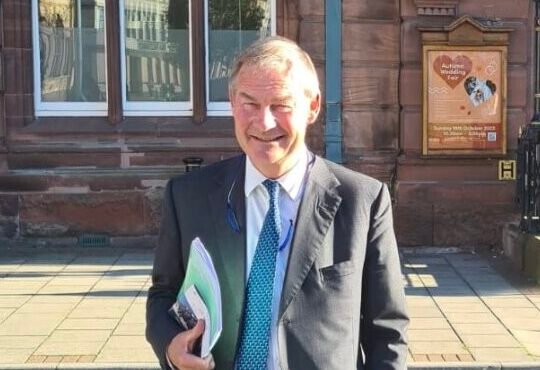
Great Yarmouth Member of Parliament Rupert Lowe has taken a decisive and vocal stand against local housing developments that threaten prime agricultural land across the Norfolk countryside. The core of this ongoing controversy centers around a contentious municipal proposal to construct 446 residential homes on exceptionally fertile farmland situated off Links Road, situated directly between Gorleston and Hopton. This expanding legal and political battle highlights significant friction within local governance, focusing sharply on the delicate balance between suburban expansion, community representation, and sustainable land stewardship.
The dispute escalated rapidly after Rupert Lowe publicly criticized the Norfolk County Council alongside its administrative development arm, Repton Property Developments, for advancing the project. Pointing out what he characterizes as a glaring contradiction between campaign pledges and actual council governance, Lowe continues to champion rural preservation and agricultural protection. The situation underscores a critical broader debate taking place across the United Kingdom, as local planning authorities struggle to reconcile national housing quotas with the urgent requirement to protect vital food security networks.
The Norfolk Farmland Dispute: What is Proposed at Links Road?
The controversial development proposal specifically targets high-grade agricultural acreage situated at a historic county farm along Links Road. Great Yarmouth Borough Council’s Development Committee granted formal planning permission for the construction of 446 market-rate and affordable residential units alongside additional care facilities. Soil scientists and regional agricultural experts emphasize that this particular stretch of land represents some of the most versatile, high-yielding, and naturally productive topsoil in the region, making its conversion to concrete a permanent environmental and economic loss.
Beyond the immediate destruction of prime farming acreage, local residents and agricultural advocates argue that regional infrastructure is completely unequipped to handle such a massive residential influx. The surrounding community already faces unprecedented operational strain across public services, including heavily oversubscribed medical practices, crowded local primary schools, and narrow road networks prone to severe congestion. Rupert Lowe maintains that paving over top-tier agricultural land directly harms future national food independence while imposing an unmanageable burden on local municipal resources.
Rupert Lowe’s Stance: “Stop the Houses, Save the Farm”
Adopting the clear campaign slogan “Stop the houses, save the farm,” Rupert Lowe has successfully elevated this local planning dispute into a broader discussion on national political accountability. After initial behind-the-scenes negotiations with county council leadership failed to alter the direction of the project, Lowe took his opposition campaign directly to the public domain. He strongly insists that elected representatives have a fundamental duty to listen to the working-class rural communities whose livelihoods and local environments are directly threatened by speculative developments.
Support for the land preservation campaign continues to build substantial momentum throughout the Great Yarmouth constituency and surrounding rural districts. Over 1,300 local citizens signed formal petitions objecting to the council’s decision to hand over active agricultural plots to suburban developers. In direct response to community backing, Rupert Lowe alongside aligned Restore Britain and Great Yarmouth First councillors are pursuing formal legal options, including exploring judicial review proceedings to challenge the validity of the council’s decision.
Political Fallout: Accusations of Hypocrisy Against Reform UK
This local battle has generated a distinct political rift between Rupert Lowe and the Reform UK-led administration managing Norfolk County Council. Reform UK previously built much of its political platform on protecting the traditional British countryside, supporting domestic farmers, and opposing reckless overdevelopment on vital greenfield sites. Lowe has openly accused local council leaders of political hypocrisy for approving large-scale housing projects on prime county farms the moment they assumed actual administrative authority over local planning committees.
This public confrontation underscores broader shifting dynamics within conservative and right-leaning British politics. Representing his party, Restore Britain, Lowe emphasizes that political movements must maintain absolute integrity and remain answerable to their voters after winning power. Disillusioned voters across Norfolk are monitoring the Links Road housing challenge as a primary test case of whether political parties will uphold their core campaign commitments when faced with the financial and bureaucratic incentives of local government administration.
Broader Context: Rupert Lowe’s Evolving Political Career
Prior to his election to Westminster as the Member of Parliament for Great Yarmouth, Rupert Lowe established an extensive career across business, international finance, agriculture, and professional sports management. Widely recognized for his former tenure as Chairman of Southampton Football Club and his service as a Member of the European Parliament, he brings a distinct commercial and practical perspective to public policy. His primary background as an active working farmer deeply informs his passionate advocacy for agricultural land rights and rural sustainability.
Now serving as the leader of Restore Britain, Rupert Lowe continues to build his political profile through direct constituency engagement and high-profile legislative campaigns. From donating his monthly parliamentary salary to essential local organizations like the Sunbeams Community Hub to spearheading challenges against municipal housing expansion, his strategy focuses on tangible local impact. His unyielding defence of the Links Road farmland aligns directly with his comprehensive national platform advocating for energy security, border enforcement, and strong economic self-reliance.
Conclusion
The high-stakes standoff over the Links Road residential project encapsulates the ongoing national struggle between rapid urban development and necessary agricultural preservation. Rupert Lowe remains at the leading edge of this conflict, demanding that municipal authorities re-evaluate long-term priorities before irreplaceable agricultural resources are permanently destroyed. As legal inquiries proceed and community organizing continues, this dispute will serve as a key reference point for local planning accountability and countryside conservation efforts across Great Yarmouth and the wider United Kingdom.
Frequently Asked Questions (FAQs)
Why is Rupert Lowe opposing the housing project in Norfolk?
Rupert Lowe opposes the project because it converts 446 homes’ worth of highly productive, top-tier agricultural land into suburban housing. He maintains that preserving domestic food production is essential for national security and that existing local infrastructure—including roads, schools, and medical facilities—cannot absorb the added population density without suffering severe strain.
Which political party does Rupert Lowe currently lead?
Rupert Lowe serves as the Member of Parliament for Great Yarmouth and is the national leader of the political party Restore Britain, having previously been elected to Westminster under the Reform UK banner.
Where is the disputed Norfolk farmland located?
The agricultural site in question is situated off Links Road, located precisely between Hopton and Gorleston within the Great Yarmouth parliamentary constituency in Norfolk.
How many homes are approved for the Links Road development?
Planning permission was formally granted for a total of 446 residential dwellings alongside additional provisions for up to 70 extra care housing units.
What actions are being taken to block the development?
Rupert Lowe, together with councillors from Great Yarmouth First and Restore Britain, has organized public petitions signed by over 1,300 residents and is actively exploring judicial review and legal avenues to challenge the decision.
You may also read: Breakthrough Acting Career: Movies and TV Shows
