
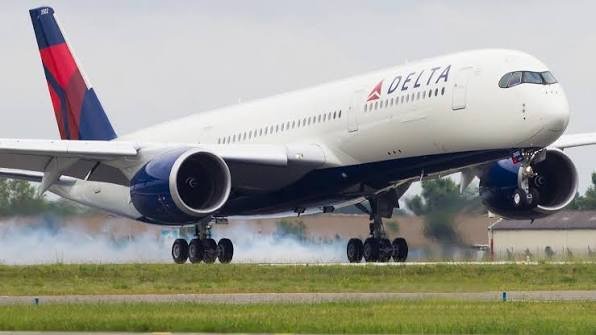
Quick Answer: Delta Flight DL275 diverted to LAX on May 28, 2025, after the flight crew received an engine anti-ice system warning while flying over the Bering Sea at 38,000 feet. The Airbus A350-900 (registration N508DNE) turned around and flew approximately five hours back to Los Angeles International Airport, landing safely on Runway 06R. No emergency was declared. No injuries were reported. The aircraft remained on the ground for approximately 18.5 hours for inspection and repairs before returning to service.
DL275 Flight Quick Facts
| Detail | Information |
|---|---|
| Flight Number | Delta DL275 |
| Route | Detroit (DTW) → Tokyo Haneda (HND) |
| Aircraft | Airbus A350-900 |
| Registration | N508DNE |
| Engines | 2 × Rolls-Royce Trent XWB |
| Diversion Date | May 28, 2025 |
| Diversion Airport | Los Angeles International Airport (LAX) |
| Runway | 06R |
| Reason | Engine anti-ice system indication |
| Emergency Declared? | No — precautionary diversion only |
| Injuries | None reported |
| Ground Time at LAX | ~18.5 hours |
| Flight Distance (DTW–HND) | ~6,200 miles |
| Normal Flight Time | ~13 hours |
What Happened: The Complete Timeline of the DL275 Diversion
Delta Flight DL275 departed Detroit Metropolitan Wayne County Airport (DTW) on the evening of May 27, 2025, bound for Tokyo Haneda Airport (HND) — one of the longest and most demanding routes in Delta’s international network. The flight followed its normal course across the North Pacific, with passengers settling into the familiar rhythm of long-haul travel.
Then, while crossing the Bering Sea at approximately 38,000 feet, the flight crew received an indication related to the engine anti-ice system on one of the two Rolls-Royce Trent XWB engines. The warning came through the aircraft’s ECAM system (Electronic Centralized Aircraft Monitor) — a centralized avionics suite that monitors all major aircraft systems and classifies warnings as advisory (white), caution (amber), or warning (red).
Following established safety protocols for extended over-water ETOPS operations, the crew made a clear and immediate decision: the flight would not continue thousands of miles further into the remote Pacific. DL275 reversed course and flew approximately five hours back toward the United States.
Delta Flight DL275 diverted to LAX and touched down on Runway 06R at Los Angeles International Airport safely on May 28, 2025. All passengers and crew disembarked without incident. The aircraft was held on the ground for approximately 18.5 hours while Delta’s maintenance engineers conducted a full inspection and completed necessary repairs before the A350-900 returned to service.
Why Did the Engine Anti-Ice Warning Trigger a Diversion?
At cruising altitude over the Bering Sea, outside air temperatures can drop to below minus 50 degrees Celsius. At those temperatures, microscopic moisture in the air can freeze and form ice crystals on the engine’s inlet components — the large circular openings at the front of each engine through which air must flow cleanly for the engine to function correctly.
The engine anti-ice system prevents this by using hot bleed air drawn from the engine compressor to keep the inlet warm and clear. When the ECAM displayed an indication related to this system, it did not automatically confirm a mechanical failure — in some cases the root cause is a sensor anomaly or a valve fault. But aviation safety protocols are absolute on this point: no crew operating an ETOPS flight over a remote ocean can assume the best-case scenario.
The guiding principle is simple and non-negotiable: treat every warning as genuine until a qualified maintenance team proves otherwise. The cost of an unnecessary diversion is measured in inconvenience. The cost of ignoring a real warning over the open Pacific is immeasurable. The crew of DL275 made the only acceptable decision.
Important: The engine did not fail. The aircraft continued flying normally throughout the return to LAX. This was a precautionary diversion, not an in-flight emergency.
Why Did DL275 Fly to LAX Instead of Anchorage or a Closer Airport?
This is one of the most common questions people ask about the DL275 diversion — and the answer is more detailed than most coverage acknowledges.
Geographic proximity alone does not determine a diversion airport. Pilots and airline dispatch teams evaluate several factors simultaneously:
Why Not Anchorage (ANC)?
Anchorage was geographically closer at the time of the diversion. However, weather conditions in Alaska at that time were cold and snowy — precisely the kind of environment you do not want when dealing with a suspected anti-ice system issue. Landing a widebody aircraft with a potential heating system fault in freezing conditions could have complicated the situation rather than resolved it. Alaska also lacks the depth of widebody maintenance capability that LAX provides.
Why LAX?
Los Angeles International Airport was the right choice for several operational reasons:
- Delta’s major West Coast hub with heavy-maintenance facilities specifically configured for widebody aircraft including the A350-900
- A350-qualified maintenance engineers on the ground, available around the clock
- Full spare parts inventory for the Rolls-Royce Trent XWB engine family
- Favorable weather conditions — no icing risk, long runways, and reliable approach conditions
- Passenger handling capability — international customs, hotels nearby, and Delta’s full customer service infrastructure
- Pre-planned contingency — LAX is designated as a primary diversion airport for Delta’s Pacific routes in advance of every departure
The choice of LAX was not improvised under pressure. It was the activation of a pre-existing contingency plan that Delta builds into every trans-Pacific operation.
What Is ETOPS and Why Does It Matter for DL275?
ETOPS stands for Extended-range Twin-engine Operational Performance Standards. It is the regulatory framework that governs how twin-engine commercial aircraft are permitted to operate on routes that take them far from the nearest suitable diversion airport. For a deeper technical overview, SKYbrary Aviation Safety — the industry’s leading open-access aviation knowledge resource — provides a comprehensive breakdown of ETOPS requirements and how they protect passengers on long-haul routes.
Without ETOPS certification, twin-engine jets would be required to stay within 60 minutes of a diversion airport at all times — a rule that would make trans-Pacific routes like DTW to HND impossible to operate directly. ETOPS certification (the A350-900 holds ETOPS-180 and beyond) allows aircraft to fly routes where they may be up to 180 minutes or more from the nearest suitable airport.
The critical point: ETOPS routes require pre-approved diversion airports. These are planned before the aircraft ever leaves the gate. When the DL275 crew made their diversion decision over the Bering Sea, they were executing a plan that already existed — they were not making it up as they went. LAX was on the pre-approved list. The decision to go there was fast, correct, and by the book.
Delta 275 Seat Map and Cabin Configuration
Delta Flight DL275 operates on the Airbus A350-900, which on this route offers three cabin classes:
- Delta One (Business Class): Fully lie-flat seats in a 1-2-1 configuration, offering direct aisle access for every passenger. Located in the forward cabin.
- Delta Premium Select: Extra-legroom recliner seats in a 2-4-2 layout. Located between business and main cabin.
- Delta Main Cabin: Standard economy seating in a 3-3-3 configuration.
For the most current and accurate seat map for DL275, including specific seat numbers, exit row locations, and bulkhead positions, visit SeatGuru or check the Delta Air Lines website directly when booking or managing your reservation. Seat configurations can vary depending on aircraft rotation.
DL275 Flight Status and Live Tracking
If you are looking for real-time DL275 flight status, the most reliable tools are:
- FlightAware — flightaware.com — Search “DAL275” for live tracking, historical data, and delay information
- FlightRadar24 — flightradar24.com — Live radar tracking with altitude, speed, and route visualization
- Delta Air Lines App and Website — The official source for gate information, departure times, and rebooking options for ticketed passengers
The DTW to HND route (Detroit Metropolitan Wayne County Airport to Tokyo Haneda Airport) typically operates daily, with departure times subject to seasonal schedule adjustments. For current status on today’s DL275 departure, the Delta app provides real-time push notifications and is the fastest way to receive updates if a delay or operational change occurs.
What the Passengers Experienced
For the passengers aboard DL275, the diversion was disorienting but, by all accounts, professionally handled. Most were well into the crossing when the aircraft banked and began heading back toward the United States — and the realization that they were no longer going to Tokyo settled over the cabin with a mix of confusion and concern.
Delta’s cabin crew responded with calm, clear communication throughout the five-hour return flight, keeping passengers informed without creating alarm. The flight deck made an announcement explaining that the aircraft was diverting to Los Angeles due to a technical indication and that safety was not being compromised.
After landing at LAX, Delta deployed customer service teams to assist hundreds of affected travelers:
- Rebooking on the next available DL275 departure or alternative routing through partner carriers
- Hotel accommodations at Delta’s expense for passengers unable to travel the same day
- Meal vouchers and transportation assistance as part of Delta’s standard diversion response
- Full refunds available for any passengers who chose not to continue travel at all
Passenger accounts described Delta’s ground response as organized and attentive, with clear communication at every step.
Your Rights as a Passenger After a Flight Diversion
If you were affected by the DL275 diversion — or any similar flight diversion — here is what you are entitled to:
Full Refund: If the diversion caused you to miss your final destination or made your journey impossible, you are entitled to a full refund of your ticket, regardless of fare class, if you choose not to travel.
Rebooking at No Cost: Delta is required to rebook you on the next available flight to your destination at no additional charge.
Hotel and Meals: For overnight diversions, Delta provides hotel accommodations and meal vouchers as part of their passenger care policy.
Travel Insurance: If you purchased travel insurance or used a credit card with trip interruption benefits, you may be eligible for additional reimbursement covering meals, ground transportation, and incidentals not covered by Delta’s vouchers.
Compensation: Under US Department of Transportation rules, airlines are not required to provide cash compensation for diversions caused by safety-related technical issues (as opposed to controllable delays). However, Delta’s customer service team can often provide goodwill miles or travel credits for significantly disrupted passengers — it is always worth asking.
What This Incident Reveals About Modern Aviation Safety
The story of Delta Flight DL275 diverted LAX is, at its core, a story about aviation safety systems working exactly as they were designed to.
The ECAM system detected an anomaly. The flight crew responded with the correct protocol. The diversion airport was the most capable available for that aircraft type. The maintenance team inspected and repaired the aircraft. Every single passenger arrived home safely.
That chain of events is not coincidental. It is the product of decades of layered investment in aircraft engineering, regulatory oversight, crew training, and airline operational culture — all functioning together in a moment that counted. The Airbus A350-900’s redundant systems are engineered specifically so that no single anomaly can cascade silently into catastrophe. Warning systems exist to give crews time, options, and information before situations worsen.
For passengers who feel uneasy about long-haul flying over remote ocean routes, this incident offers something counterintuitive but genuine: reassurance. The same systems that caused this diversion are the systems that make commercial aviation statistically safer than almost any other form of transportation.
Frequently Asked Questions (FAQs)
Why did Delta Flight DL275 divert to LAX? Delta Flight DL275 diverted to LAX on May 28, 2025, after the flight crew received an engine anti-ice system indication while flying over the Bering Sea at approximately 38,000 feet. Following ETOPS safety protocols, the crew reversed course and flew approximately five hours back to Los Angeles International Airport, where Delta has dedicated heavy-maintenance facilities for the Airbus A350-900. All passengers and crew landed safely. No emergency was declared.
What is Delta Flight DL275? Delta Flight DL275 is a scheduled international long-haul service operated by Delta Air Lines, connecting Detroit Metropolitan Wayne County Airport (DTW) with Tokyo Haneda Airport (HND). The route covers approximately 6,200 miles and is operated using an Airbus A350-900, typically logging around 13 hours of flight time each way.
What aircraft does Delta DL275 use? Delta Flight DL275 operates on an Airbus A350-900 with registration N508DNE. The aircraft is powered by two Rolls-Royce Trent XWB engines and is configured with Delta One business class, Delta Premium Select, and Delta Main Cabin seating.
Was anyone hurt when DL275 diverted to LAX? No. The diversion was entirely precautionary. No emergency was declared, and no injuries were reported. All passengers and crew members disembarked safely at LAX.
Why did DL275 go all the way to LAX instead of Anchorage or another closer airport? Anchorage was geographically closer, but weather conditions in Alaska were cold and snowy — problematic for an aircraft dealing with an anti-ice system issue. LAX offered superior maintenance facilities, A350-qualified engineers, full spare parts inventory, better weather, and Delta’s complete customer service infrastructure. LAX was also pre-designated as a diversion airport in Delta’s ETOPS planning for this route.
Did the engine fail on DL275? No. The engine did not fail. The aircraft received an anti-ice system indication — a warning about a potential issue with the system that prevents ice from forming on the engine inlet. The aircraft continued flying normally throughout the return to LAX. This was a precautionary decision, not a response to engine failure.
What does an engine anti-ice warning mean? An engine anti-ice warning signals a potential fault in the system that prevents ice from accumulating on the engine’s inlet components during flight at high altitude. While the cause can sometimes be a sensor issue rather than a mechanical failure, ETOPS protocols require crews to divert and have the system inspected by qualified maintenance personnel before continuing over remote ocean routes.
How long was DL275 on the ground at LAX after the diversion? The aircraft remained on the ground at LAX for approximately 18.5 hours for inspection and repairs before returning to service.
What is ETOPS and how did it affect the DL275 diversion decision? ETOPS (Extended-range Twin-engine Operational Performance Standards) is the regulatory framework allowing twin-engine aircraft to fly routes far from diversion airports. ETOPS requires airlines to pre-approve specific diversion airports for each route. When the DL275 crew decided to divert, they activated a pre-planned response — LAX was already designated as an approved diversion airport for this Pacific route.
What did Delta do for passengers after the diversion? Delta arranged rebooking on alternative flights to Tokyo Haneda, provided hotel accommodations at Delta’s expense, issued meal vouchers, and deployed customer service teams at LAX to manage the disruption. Passengers who chose not to continue travel were entitled to a full refund.
How can I track DL275 flight status in real time? Live tracking for DL275 is available on FlightAware (search “DAL275”) and FlightRadar24. Delta’s website and mobile app also provide real-time departure and arrival updates for ticketed passengers.
Is it safe to fly the DTW to HND route after this incident? Yes. The DL275 diversion is evidence that aviation safety systems are functioning correctly — not evidence of systemic risk. Every system performed as designed: a warning was detected, a decision was made, and everyone arrived home safely. The DTW to HND route, operated on the Airbus A350-900, remains one of the most technically capable and safety-managed routes in commercial aviation.
Last updated: June 2026. Flight details sourced from aviation tracking records, official airline data, and verified incident reports.
Related Aviation Incidents You May Find Helpful
Precautionary diversions are not unique to Delta. If you are interested in how other airlines handle unexpected in-flight situations, you may find our detailed coverage of the EasyJet Flight U2238 Emergency Landing at Newcastle useful — a similar case study in how modern aviation safety protocols protect passengers when the unexpected happens mid-flight.
