

Build or rent? If you are deciding whether to invest in an on-premise data center or move to rack colocation in a professional data center, this article provides a straightforward comparison of both approaches—without marketing jargon and with a clear focus on costs, infrastructure control, and real-world scalability.
Both options—an on-premise data center and rack colocation—allow organizations to maintain full control over their hardware and data. The difference lies in who is responsible for the physical infrastructure, how each model impacts the company’s budget, and how quickly the environment can adapt to changing business requirements. Let’s take a closer look at both approaches.
Rack Colocation: Leased Space, Full Control
Rack colocation—a form of data center colocation—allows a company to place its own servers, networking equipment, and storage systems into leased rack space within a third-party facility. The hardware and data remain entirely under the company’s ownership and control, while the provider supplies the physical infrastructure, including redundant power, cooling, high-speed connectivity, and facility security.
The result is access to enterprise-grade infrastructure without the need to build and maintain it from scratch. Companies no longer have to worry about backup generators or whether their cooling systems can handle future demand—those responsibilities belong to the provider, whose data center has been specifically designed and certified for such requirements.
An on-premise data center, on the other hand, places the organization in the role of a full-scale operator. Everything from room design and infrastructure planning to replacing a failed power supply falls on the internal team. This approach delivers maximum sovereignty but also maximum responsibility for operations, staffing, and budget management.
Tip: If you are looking for a carrier-neutral rack colocation provider with more than 20 years of experience and two data centers in Prague, consider https://ttc-teleport.cz/en/.
Rack Colocation vs. an On-Premise Data Center: CapEx or OpEx?
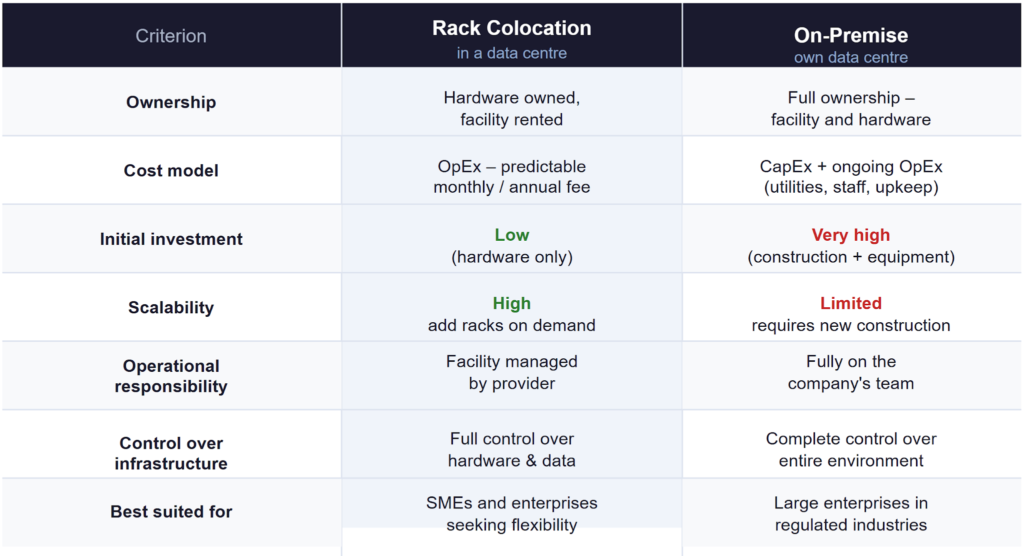
An on-premise data center requires a significant capital expenditure (CapEx) long before the first server is installed. The costs of building or adapting a facility, implementing cooling systems, backup power infrastructure, physical security measures, and internet connectivity can easily reach millions of dollars—before factoring in ongoing operational expenses (OpEx) such as energy consumption, maintenance personnel, and regular infrastructure upgrades.
Rack colocation shifts the model from CapEx to OpEx. Instead of investing heavily in physical infrastructure, companies pay a predictable monthly or annual fee for rack space, power, cooling, and connectivity. Hardware acquisition costs, such as servers, switches, and storage systems, remain the company’s responsibility, but the expenses associated with building and operating the facility itself are eliminated.
For medium-sized and large organizations, this difference often translates into replacing a large upfront investment with a planned operational expense that is easier to forecast, review, and adjust as business requirements evolve. One of the major benefits of colocation is this financial flexibility, allowing organizations to focus resources on business growth rather than infrastructure management.
Scalability and Operational Complexity: Where Rack Colocation Has the Advantage
Scaling an on-premise data center is rarely simple. Increasing capacity often requires construction work, additional technologies, or major infrastructure upgrades—all of which consume both time and capital. Companies that overestimate future demand frequently end up paying for unused capacity for years.
Rack colocation works differently. Expanding capacity is typically a matter of adding another rack under an existing agreement rather than undertaking a construction project. This gives organizations the flexibility to respond to growth without overinvesting in infrastructure they may not need immediately.
The operational demands of an on-premise data center should not be underestimated. Power management, cooling, physical security, and around-the-clock monitoring require a dedicated team of specialists. These costs continue every month regardless of actual utilization.
With rack colocation, those responsibilities are handled by the provider, which distributes infrastructure and operational costs across multiple customers. As a result, organizations gain access to a higher technical standard than they could often achieve on their own, while benefiting from greater efficiency and many of the practical benefits of colocation.
On-Premise Data Center or Rack Colocation?
An on-premise data center makes sense when an organization operates in a highly regulated industry, such as finance or healthcare, and requires complete physical isolation of its data. It is also suitable when the company has an experienced IT team capable of designing, operating, and continuously developing the entire infrastructure. This model is typically chosen by large enterprises with stable capacity requirements and a clearly defined long-term strategy.
Rack colocation, on the other hand, is often the better fit for organizations that
- Do not want to build their own on-premise data center but require reliable, certified, enterprise-grade infrastructure.
- Expect rapid growth and need the flexibility to scale without overprovisioning capacity.
- Want to retain full control over their hardware while eliminating the operational burden of facility management.
Companies typically move from an on-premise data center to rack colocation when their existing server room reaches its capacity limits or when the IT team spends more time maintaining infrastructure than supporting business growth. In most cases, this is a clear sign that the current operating model needs to be reconsidered.
Before You Decide
The choice between rack colocation and an on-premise data center is not purely a technical decision. It is a strategic question about where the organization wants to invest its capital and focus the time and expertise of its IT team.
The most effective organizations do not invest in infrastructure simply because they can operate it. They invest in it only when doing so provides a measurable competitive advantage. Otherwise, the long-term benefits of colocation—including scalability, predictable costs, and reduced operational burden—often make data center colocation the more practical and economically efficient option.
